
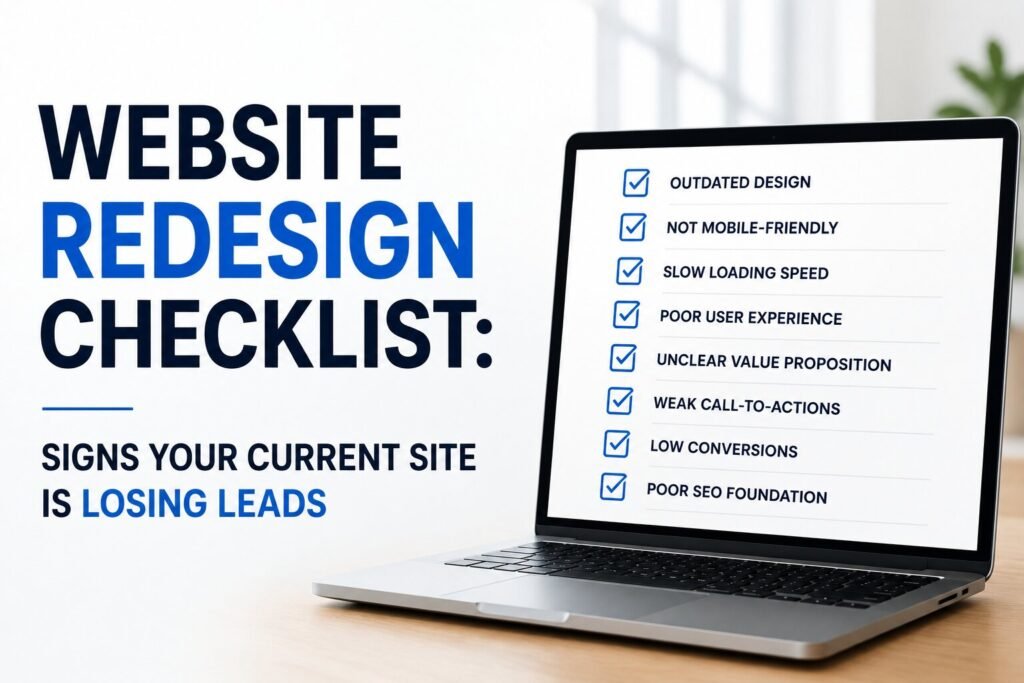
Key signs your website is losing leads include page load speed over 3 seconds, a poor mobile experience, below-benchmark conversion rates, declining search rankings, confusing navigation, outdated design, security vulnerabilities, content updates that require a developer, high bounce rates, and competitors with stronger websites.
Digital companies rely heavily on websites today, which are their main advertising and selling tool and can work anytime to attract and convert customers. But a lot of them do not realize that they have websites that are repelling visitors instead of involving them. A recent survey has highlighted that 88% of customers will not come back even after a bad website experience, and the average conversion rate of around 2.35% means even small website performance issues result in a big loss of business.
The professional development of a website deals creatively with these challenges, transforming digital disadvantages into sales advantages. The website redesign checklist helps you identify twelve major red flags that point to the exact time you should look for expert help.
1. Page Load Speed Exceeds Three Seconds
You see, website speed has a direct effect on user satisfaction, and that’s another reason why your website must load very fast; otherwise, your visitors will leave your site. Based on Google, a study revealed that a page download time of 1-3 seconds could increase the visitor bounce rate by 32%. Beyond that user discomfort factor, which is page load time itself, page speed was also confirmed to be a major ranking factor. Slow websites will not only get very limited exposure in the search engine results pages (SERP) but also be able to lose out on a large portion of organic traffic opportunities.
By the way, professional website development services will speed up your site with clean code, lossy image compression, a good content delivery network (CDN), and strategic use of caching. They manage such website optimizations that the pages would load in less than 2 seconds, which should keep your visitors engaged and search engines happy as well.
2. Mobile Experience Fails User Expectations
Almost 60% of website traffic now comes from people using their mobile phones. As such, making a web page easy to use on mobile devices is a must. A bad website design on a phone can really annoy the user. If, for instance, a visitor comes to your site via their phone and the layout looks terrible, or even the buttons are really too small to be easily tapped, the first thing the user would do is look up the competitor’s site. That’s the reality for such websites: they lose business straight away. Google’s policy of ranking mobile versions first essentially means that mobile experiences are what Google uses to decide how relevant a site is.
Websites that do not provide a mobile user with a good experience will be directly penalized by Google through less website exposure in their search results. Web designers nowadays are including mobile-responsive systems into development processes, which allows a design to fit into any screen size, still delivering its intended function. This ensures that mobile-dominant consumers can access the website effectively, and at the same time, companies will not lose their search rankings due to that.
3. Conversion Rates Fall Below Benchmarks
Visually speaking, a conversion rate under 2.35% means a site has not delivered its core business objective. Conversion is the process of a visitor becoming someone who takes desired actions, and when this drops off sharply from 2.35% downward, it is an indication that problems in the areas of marketing, advertising, or product design have occurred.
If there is a drop-off in visitors becoming paying customers and the website is unable to make them take that next step, it may be time to think about doing an effective redesign of the site with the expertise of CRO (conversion rate optimization) experts. Such experts would work with the development teams in analyzing the data on how site visitors behave, pinpointing problem areas that may cause visitors to get stuck, making test runs, and optimizing different elements until they get results that maximize conversion.
4. Search Engine Rankings Continue Declining
About five out of every ten website visitors come via organic search; this means that the business should always focus on how well their site can be accessed through the search engines, in particular by doing SEO. Getting lower rankings could be pointing out very serious issues: the old way of doing SEO is being used, the website has a bad technical foundation, or it is not providing search intention-matching content.
The algorithms nowadays are rewarding search engine visitors who have great experiences when interacting with a site: fast-loading websites, good design, etc. A skilled site developer can incorporate SEO-friendly practices into website design right from planning, making a good website structure, clean code, proper internal linking, optimized metadata, and including structured data markup in their work. Doing SEO before a site launch helps it achieve better ranking instantly on the search engines compared to one that has to be optimized after launching for a while.
5. Navigation Creates User Confusion
Click N Cuts should provide website visitors with an interface or navigation layout that allows them to locate their required information easily and quickly. It has been recommended that navigation should be done through no more than three clicks.
Navigation that is confusing often means user frustration. Apart from the impact on website visitors, confused navigation can actually impair the efficiency of site spidering performed by search engines. A redesign plan done at the level of strategy can make website navigation easier, establish logical hierarchies, and set up user-friendly systems that will satisfy both the needs of human users and the technical requirements of search engines.
6. Visual Design Appears Outdated
First impressions are made within 50 milliseconds online. Old-fashioned styles instantly inform users that a company may be outdated in its operations.
Today’s website development is a combination of visual appeal and practical performance. Simple page layouts, thoughtful use of white space, excellent pictures, and the maintenance of brand consistency can be very effective in creating a favorable impression of the website that leads to customer trust and involvement, which also reflects the brand’s place in the market and its understanding of its customers very correctly.
7. Security Vulnerabilities Exist
Websites that do not have HTTPS encryption show a “Not Secure” message on them that discourages visitors from interacting with them, and that’s why it affects visitor trust. Google has HTTPS as a ranking factor, which basically implies if a site is not secure, the site has to suffer SEO issues. A truly secure environment involves not just SSL certificates but also things like keeping up with updates, hosting that is secure, malware protection, and data safeguarding.
Pro website developers usually focus on the security part while building websites. Through layered protections, they ensure that not only are the customers secure, but also the security aspects that the search engines give importance to are maintained.
8. Content Updates Require Developer Help
When developer input is needed for even minor content changes, it causes significant delays and operational disruptions. This reliance leads to untimely content releases, which are vital when timely content delivery is linked to high user engagement and good search ranks.
On top of all that, there are website development practices using content management systems that allow marketers to do their job content-wise independently. With this flexibility, companies can refresh content, stay on top of current market trends, post regular blog entries for SEO, and keep the content updated—all factors the search engines favor.
9. Analytics Show High Bounce Rates
Bounce rates over 70% may point to a major problem with engagement. High bounce rates tell search engines that a website’s content is not keeping visitors, and the site’s ranking over time could be affected due to that.
Slow loading times, misleading titles, low-quality content, or poor mobile optimization are the usual causes behind a high bounce rate. Professional website redesign companies look into statistics and pinpoint particular areas of friction that lead visitors to bounce and design specific strategies that not only bring down bounce rate but also enhance overall engagement with the website.
10. Competitors Deliver Superior Experiences
When competitors have sites that load faster and work smoothly, achieve higher search rankings, make better sales, and look much more professional in appearance, your business will inevitably experience competitive disadvantages. In many cases, a better web appearance will be the reason customers choose one product or service over another from several competitors.
Keeping up with and being one step ahead of competitors in website development means knowing what the standard is in your industry as well as your niche and then going far beyond. It entails the application of the most current optimization methods, the development of unique user experiences, and ongoing tracking and adjustment of what has been done to keep your site the trendsetter rather than the copycat in the respective domain.
Ready to Transform Your Website?
Your website is more than a design; it’s supposed to work as a business tool. If your website is getting slower, hard to use, no longer trendy, or you aren’t getting enough requests, you should definitely consider a redesign. An updated website gives a better experience, shows more professionalism, boosts your marketing, and contributes to overall business success. We make websites with all the latest tech and trends that can easily be visited by users on mobile phones and also get the attention of search engines like Google, which will help them convert visitors into potential customers. So if you’re after great website design services in Windsor, Ontario, our team will build a website that represents your business and gives you better business results.